


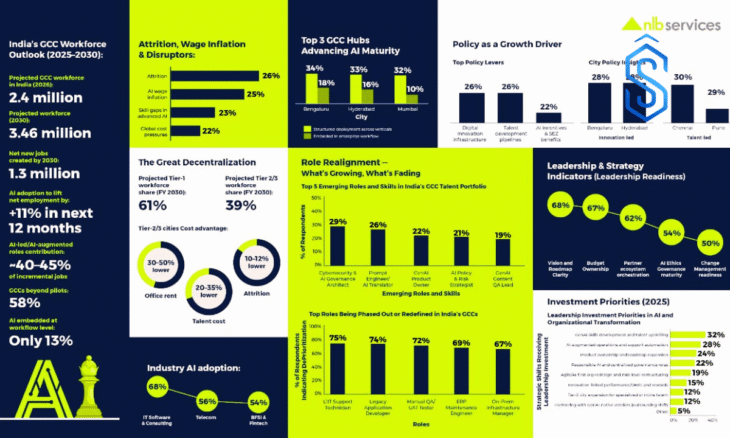
Pune: India’s AI-Native GCC Workforce is on track for a major expansion, with the total employee base expected to hit 3.46 million by 2030, according to NLB Services’ new report, “Workforce 2.0 Reset – India’s GCCs Go AI-Native.”
The study reveals that more than 58% of Global Capability Centers (GCCs) have moved beyond AI pilot stages, setting the foundation for 1.3 million net new jobs by the end of the decade. An 11% increase is anticipated in 2026 alone, pushing the GCC workforce to 2.4 million.
AI-Native GCC Workforce Transformation Accelerates Across India
The report highlights strong momentum in Generative AI (GenAI) adoption, with nearly 70% of GCCs investing in GenAI in 2025. Over 60% of companies plan to establish dedicated AI safety and governance teams by 2026, while 75% aim to integrate GenAI into everyday business operations within a year.
Also Read: The Standard India Launches New GCC in Bengaluru and Pune; Mohua Sengupta to Lead Operations
These advancements are reshaping job structures, leading to the redesign of 27% of mid-level and 25% of junior technical roles.
Sachin Alug, CEO of NLB Services, emphasized that India is entering a pivotal GCC 4.0 phase, marked by innovation, governance, and AI-heavy transformation. He noted that the projected AI-Native GCC Workforce surge of 30% by 2030 is fueling India’s evolution from delivery centers to AI-driven global enterprises.
Rise of New-Age AI Roles as Legacy Jobs Decline
With AI now central to operations, GCCs are witnessing the emergence of new roles such as:
- Cybersecurity and AI Governance Architects (29%)
- Prompt Engineers (26%)
- GenAI Product Owners (22%)
- AI Policy & Risk Strategists (21%)
Simultaneously, several traditional roles are being phased out, including L1 IT Support (75%), legacy application development (74%), manual QA (72%), and on-premise infrastructure management (67%), as organizations shift to AI-native, product-centric teams.
Tier-2 and Tier-3 Cities Fuel AI-Native GCC Workforce Growth
The report notes a significant geographic shift, with GCCs increasingly establishing delivery centers in Tier-2 and Tier-3 cities due to 20–35% talent cost savings, 30–50% lower office expenses, and 10–12% lower attrition rates.
According to Varun Sachdeva, SVP & APAC Head at NLB Services, about 39% of India’s GCC workforce will operate from emerging cities by 2030, creating 0.715 million new jobs.
Cities such as Coimbatore, Ahmedabad, and Bhubaneswar are evolving into specialized hubs, while Tier-1 metros continue to anchor leadership, governance, and R&D.
Also Read: Finance Roles in GCCs Set to Surge as India Becomes a Global Back-End Powerhouse: ACCA
Upskilling Becomes a Priority for the AI-Native GCC Workforce
The AI-Native GCC Workforce transformation is driving large-scale capability development initiatives. Nearly 80% of GCCs are investing in continuous learning, role-specific reskilling, and corporate academies. Key upskilling models include:
- Role-based micro-credentials (18%)
- Corporate academies and focused programs (17%)
- AI-integrated career frameworks (16%)
To bridge GenAI skill gaps, 38% are hiring externally, while 22% are building internal AI academies, explained Abhilash Raghavan, Chief Business Officer – GCC Vertical at NLB Services.
Leadership, Governance, and State Policies Strengthen AI Adoption
Hyderabad and Bengaluru lead in AI leadership maturity, with 70% and 69% of GCCs demonstrating strong readiness in vision and budget ownership. Telecom & Internet Services (70%), BFSI & Fintech (69%), Media & Gaming (67%), and Software & Consulting (65%) sectors exhibit robust AI investment strategies.
AI governance is rapidly maturing as well, with 33% of GCCs establishing central AI committees and 29% deploying decentralized oversight frameworks. Delhi/NCR and Bengaluru lead centralized governance, while Hyderabad and Mumbai lean toward decentralized models.
India Positioned as a Global Hub for AI-Native GCC Workforce Development
The report underscores that progressive state policies, strong digital infrastructure, and a deep STEM talent pipeline are accelerating India’s emergence as a global AI engineering and governance hub.
As GCCs move from experimentation to full-scale AI deployment, India is set to strengthen its position as the worldwide center for AI innovation, analytics, and responsible enterprise transformation.